

Your phone reduces your cognitive capacity by 26% just by sitting on your desk, even when silent and face down. Here is what the research says and exactly what to do about it.
Most students try to study with their phone on the desk, switched to silent, face down. They believe this is enough. Research published by the University of Texas proves it is not even close.
The problem is not notifications. The problem is proximity. Your phone does not need to buzz, light up, or make a sound to reduce your ability to think. It just needs to exist near you. Once you understand the mechanism behind this, the solution becomes obvious, and the results are immediate.
Why Your Phone Hurts Your Focus Even When You Are Not Using It
A University of Texas study tested 800 participants across three conditions: phone on the desk, phone in a bag or pocket, and phone in another room. Participants completed cognitive tasks in each condition while the phone remained untouched throughout.
Peer-Reviewed Research University of Texas at Austin
The results were unambiguous. Participants with phones on their desks performed significantly worse on cognitive tasks than those with phones in another room. Even participants with phones in their bags performed worse than the phone-in-another-room group. The effect was strongest among people who reported high smartphone dependence — exactly the students who most need to focus.
The mechanism is what makes this finding so important. When your phone is nearby, your brain does not simply ignore it. It runs a continuous background process — a low-level monitoring of the phone's presence and the potential for new information. This background process consumes cognitive resources that would otherwise go to your work. You are not distracted by your phone. You are depleted by it.
Psychologist Daniel Wegner's ironic process theory explains why this happens. The more you try not to think about something, the more your brain monitors for it. Trying not to check your phone paradoxically keeps it active in your mental workspace. Willpower-based strategies have a ceiling. Physical separation does not.
Silent mode addresses one problem. Proximity is a completely different problem. The only strategy that works is putting your phone somewhere you cannot casually reach it.
What a Typical Study Session Actually Looks Like With a Phone Nearby
Here is the math that most students never calculate for themselves. In a typical two-hour study session with a phone on or near the desk, the average student checks their phone five to eight times and consistently underestimates this by more than 50 percent. Each check consumes two to five minutes directly. Each check then requires up to 23 minutes of recovery time before deep focus returns. By the time the two hours end, effective study time amounts to roughly 30 to 50 minutes.
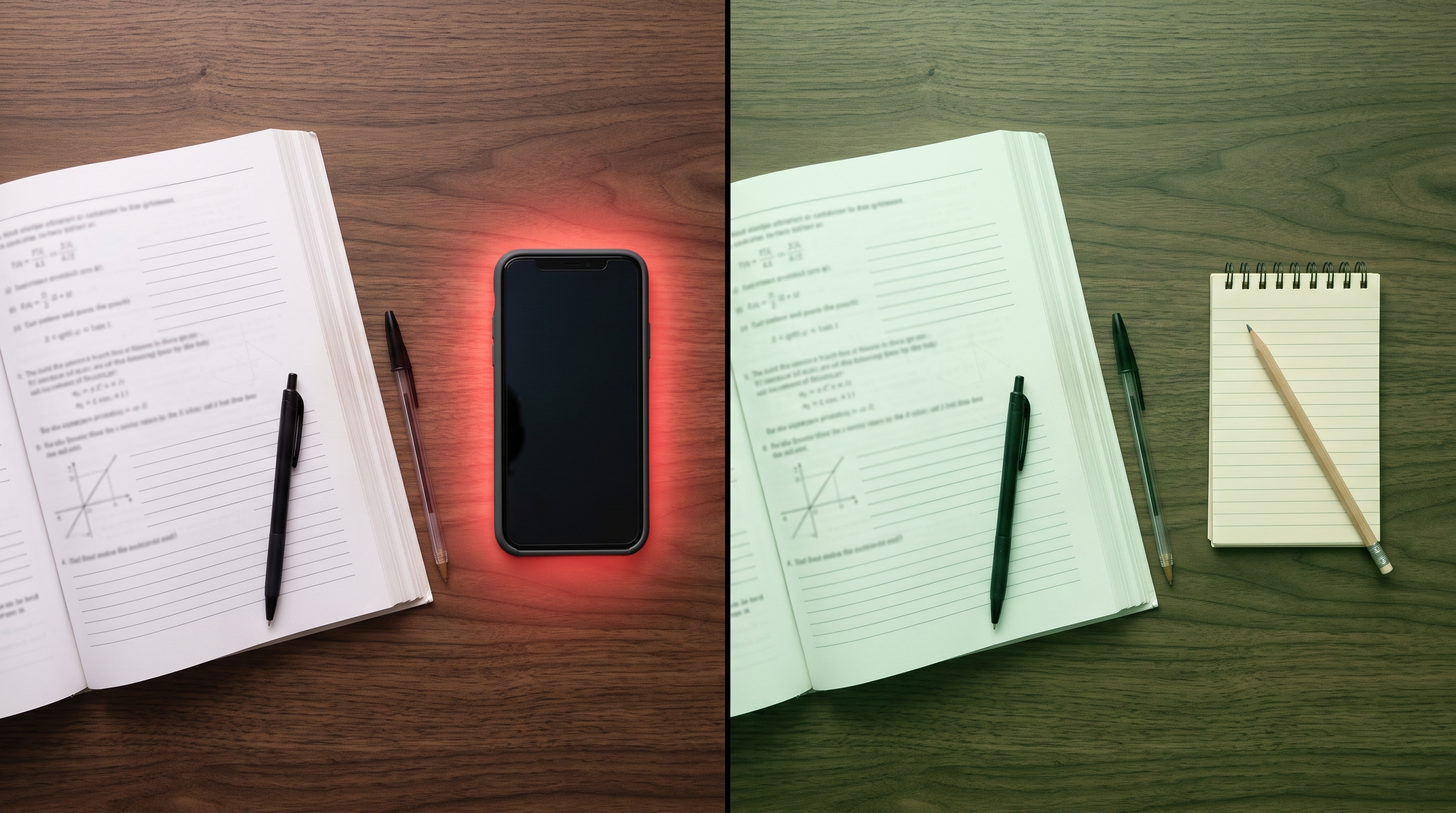
Phone On Desk — 2 Hours
What do you think is happening
Studying for 2 hours with occasional breaks to check messages. Feels productive because time is being spent.
Phone In Another Room — 2 Hours
What is actually possible
Up to 110 minutes of genuine deep work. Flow states become possible. Material is retained and understood, not just covered.
Two hours of phone-free studying consistently produce more retained learning than four hours of studying with a phone nearby. Over a full semester, that difference compounds into thousands of hours of effective study time gained or lost.
The Method Step by Step
The strategy is simple. The execution is not always easy. Here is a progressive system that works for students who have never studied without their phone and those who have tried and failed before.
Put Your Phone in a Different Room, Not Your Bag
A bag or pocket performs better than a desk but worse than another room. This is not a minor detail. The research tests these conditions separately and finds a meaningful difference between in-pocket and out-of-room. Put the phone in the next room. If you live in a single room, put it in a drawer behind you somewhere that requires standing up and making a deliberate physical decision to retrieve it.
Start With 25-Minute Blocks, Not 3 Hours
Phone separation anxiety is real and documented. The anxiety typically peaks in the first five minutes and drops sharply after that. Start with one 25-minute phone-free block. After the block, check your phone if needed. Over the first week, extend to two consecutive blocks. By week two, most students reach 60 to 90 minutes without the urge becoming significant.
Use the Parking Lot Technique for Urges
Keep a small notepad beside your books. Every time an urge to check your phone arrives, and it will, especially in the first few sessions, write down what you wanted to check. "Reply to message." "Check the score." "Look up that thing." Writing the thought down tells your brain the impulse is captured and will not be lost. The urge passes within 30 to 60 seconds almost every time.
Use a Scheduled App Blocker for Your Most Distracting Apps
For students who find themselves retrieving their phone anyway, an app blocker adds the final layer of friction needed. Detach blocks social media and entertainment apps on a schedule you set in advance. During your study window, the apps are genuinely unavailable- not delayed, not hidden behind a timer. The block holds automatically without requiring you to make the same decision forty times per session.
Take Genuine Phone-Free Breaks
Checking your phone during a study break does not rest your brain. It adds new cognitive load: messages, updates, social content immediately before you need to re-enter focused work. Real breaks are physical: walk, stretch, get water, look out a window. Students who take phone-free breaks consistently report that their next study block starts faster and feels clearer than those who scroll during breaks.
The silent mode trap: Silent mode, Do Not Disturb, and face-down placement all address auditory and visual interruptions. None of them addresses the mere presence effect. If your phone is within arm's reach, the cognitive cost remains. Distance is the only solution that the research supports.
What Changes After One Week of Phone-Free Studying
The benefits are not gradual. Most students notice a sharp difference within the first two or three sessions. Study sessions feel cleaner. Material feels easier to understand and remember. The end of a session feels like genuine completion rather than the scattered exhaustion of an interrupted two hours.
The compounding effect: After the first week, the anxiety of separation fades entirely for most students. By the end of the first month, phone-free studying feels like the default rather than an effort. The contrast between a focused session and a distracted one becomes so obvious that going back feels genuinely uncomfortable.
Over a full semester, the difference in academic performance is measurable. But the less obvious benefit is the reduction in study-related stress. When you know your study time is genuinely productive rather than performative, you need less of it and the time you do spend feels like it counts.
Block the Apps. Keep the Focus.
Detach is free. Set your study window blocks in under 5 minutes. No subscription. No account required.
Frequently Asked Questions
Does having your phone nearby actually affect studying even if you do not touch it?
Yes. A University of Texas study of 800 participants found that the mere presence of a smartphone on a desk reduced cognitive capacity by up to 26 percent compared to having it in another room, even when the phone was face down, on silent, and untouched. The effect occurs because your brain continuously monitors the phone's presence and allocates cognitive resources to suppressing the impulse to check it. This background process reduces the mental bandwidth available for studying without any direct phone use occurring.
Is putting my phone on silent or Do Not Disturb enough when studying?
No. Silent mode and Do Not Disturb remove auditory and visual notifications but do nothing about the cognitive cost of proximity. The University of Texas research tested the in-pocket condition of the phone on silent, not visible, separately from the other-room condition, and found that in-pocket still performed worse than out-of-room. The only condition that fully removes the mere presence effect is putting the phone in a different physical location. Silent mode is better than notifications on, but it is not a substitute for distance.
How long should I study without my phone as a beginner?
Start with 25 minutes. This is enough time to experience a genuine, focused session without triggering overwhelming phone anxiety. After completing one 25-minute block, take a 5-minute break and check your phone if needed. Over the first week, extend to two consecutive 25-minute blocks. Most students reach 60-minute phone-free sessions comfortably within 10 to 14 days. The discomfort in early sessions is real, but it peaks in the first five minutes and diminishes quickly with repetition.
What if I need my phone for study apps or a timer?
Use the web or laptop version of study apps where possible; most major platforms, including Anki and Quizlet, have browser versions. For a timer, use a laptop-based timer or a cheap physical kitchen timer. If you genuinely must use your phone for study purposes, enable airplane mode, disable all notifications and place it face-down behind you so retrieving it requires a deliberate physical action. Blocking social media and entertainment apps using a tool like Detach while keeping study apps accessible is also an effective compromise.
Can an app blocker help me study better?
Yes, specifically when combined with physical distance from your phone. An app blocker that schedules blocks in advance removes the daily decision cost of staying off social media during study sessions. Tools like Detach block specific apps during set windows, so the choice is made once and holds automatically. This is most effective when the phone is also in another room, because the blocker addresses compulsive app opening while distance addresses the mere presence effect. Together, they remove both dimensions of phone distraction.
How do I deal with the urge to check my phone while studying?
Use the parking lot technique: keep a notepad beside your study materials and write down whatever you want to check every time the urge arises. This captures the thought so your brain does not need to keep returning to it. The urge typically passes within 30 to 60 seconds once it is written down. Over the first week, the frequency of urges drops significantly as your brain adjusts to the new pattern. Most students report that by day five, the impulses are noticeably weaker and less frequent than on day one.