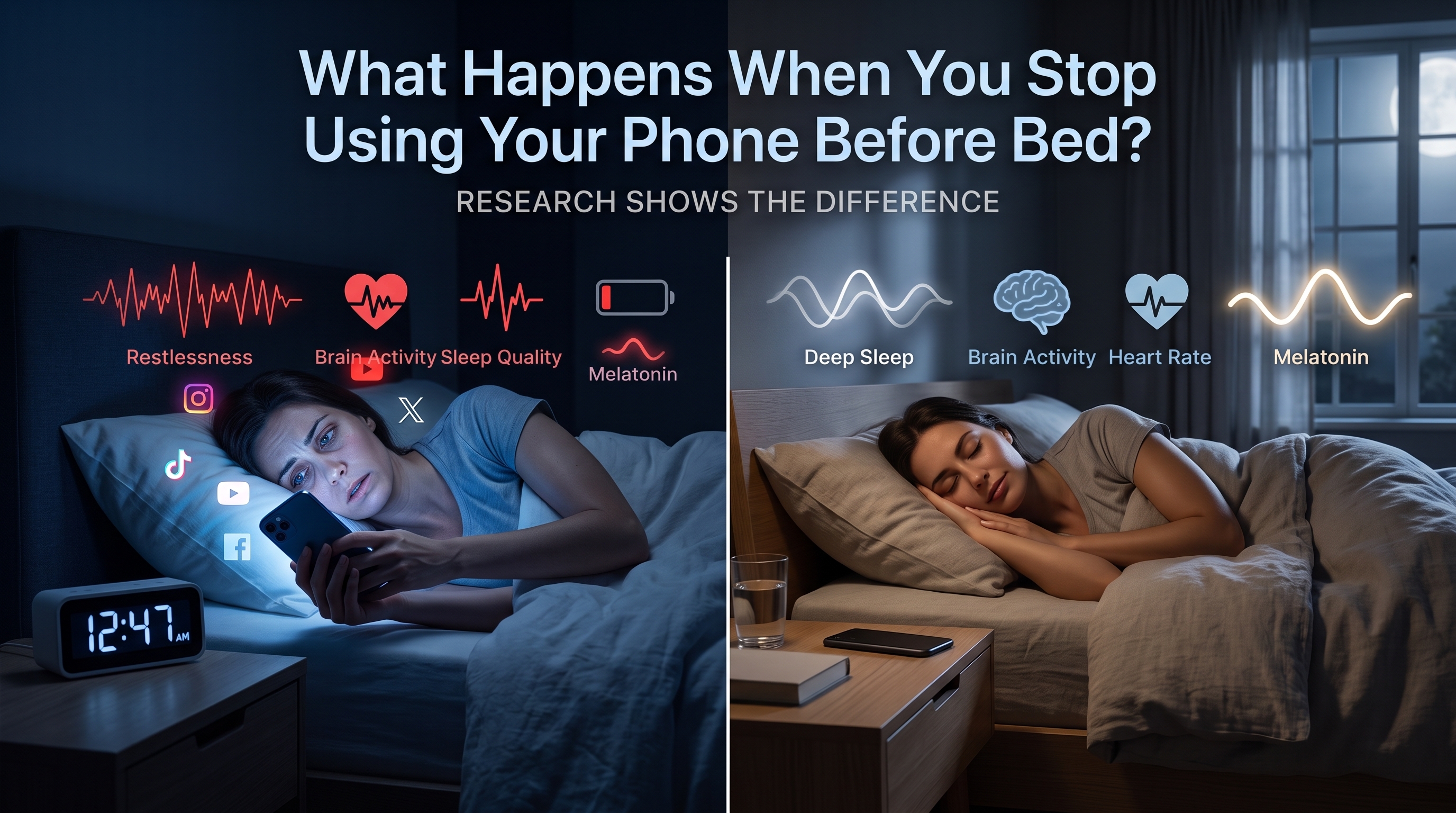




Nearly 9 in 10 people do this every single morning. Here is what it costs you, why it is so hard to stop, and the week-long plan that actually works.
Your alarm goes off. Before your feet touch the floor, you have already read three notifications, opened one app you did not mean to open, and absorbed a piece of news that will sit in the back of your mind for the next four hours.
You did not decide to do any of that. It happened automatically, in the first ninety seconds of being conscious. And it has quietly set the tone for your entire day.
Why Your Brain Reaches for the Phone Automatically
The first thirty minutes after waking are neurologically unusual. Your brain is transitioning out of sleep and into full conscious awareness. During that window, it is unusually receptive, which is exactly why what you feed it matters so much.
Your phone exploits this perfectly. After seven or eight hours without stimulation, that first unlock delivers an intense dopamine response. Messages, likes, updates, news- all of it arrives at once, at the exact moment your brain is most primed to absorb it.
The result is a raised dopamine baseline for the rest of the day. Everything that follows feels slower and less interesting by comparison. Deep work feels harder. Boredom feels less tolerable. You spend the day chasing the same hit your phone gave you before breakfast.
You are not starting your day. Your phone is starting it for you, and handing you the leftovers.
What It Actually Costs You
The morning scroll is not a neutral habit. Research consistently links it to three measurable outcomes.
Elevated stress before the day begins. Notifications, emails, and news headlines trigger a low-grade stress response within seconds of waking. You start the day already behind, already reacting.
A fragmented attention span for hours afterward. Morning routines have an outsized influence on the rest of the day. Priming your brain with rapid, high-stimulation content in the first ten minutes trains it to expect that pace all day long.
The loss of your sharpest hour. The first waking hour is when most people have their highest cognitive clarity. Trading it for a scroll session is the most expensive swap in your daily schedule.
The 7-Day Plan to Break It
You do not need to quit your phone. You need to move it out of the first hour. Here is the sequence that works.
Day 1
Buy an alarm clock
This is the whole foundation. As long as your phone is your alarm, your first conscious action of the day is reaching for it. A basic alarm clock costs less than a coffee and removes the trigger entirely.
Day 2
Charge your phone in another room
Not on the nightstand. Not face down. In a different room, behind a door. The distance is the mechanism. If retrieving it requires standing up and walking, the automatic reflex breaks on its own.
Day 3
Set a 30-minute app block
Even with the phone in another room, most people cave by day three. Schedule a block on social media and news from your wake time until 30 minutes later using Detach. The apps are genuinely unavailable — no negotiation required at 7am.
Day 4
Give the first ten minutes a job
An empty morning gets refilled by the old habit. Pick one small physical action and do it every day: drink a glass of water, open the curtains, stretch for two minutes. The action becomes the new default.
Day 5
Extend the block to 60 minutes
By day five, the discomfort has usually dropped sharply. Push the block out to a full hour. This is the point where most people notice their mornings feel genuinely different — calmer and less rushed.
Day 6
Get natural light before screen light
Open a window or step outside within the first fifteen minutes. Morning daylight regulates your circadian rhythm and produces genuine alertness, the thing you were unconsciously seeking from the phone in the first place.
Day 7
Compare and lock it in
Ask one question: did this week's mornings feel better than last week's? For almost everyone, the answer is obvious. Keep the block running permanently so the decision never has to be made again.
The part that trips people up: Do Not Disturb and Focus modes do not solve this. They silence alerts but leave the apps one tap away, and at 7 am, one tap is all it takes. The block has to be real, not a reminder.
Why This Works When Willpower Does Not
Every version of this advice tells you to be more disciplined in the morning. That fails because willpower is lowest in the moments right after waking, when your prefrontal cortex is still coming online.
The plan above works because none of it depends on resisting anything. The alarm clock removes the trigger. The other room removes the access. The scheduled block removes the decision. By the time you are awake enough to want your phone, the habit loop has already been interrupted.
Start with just Day 1 and Day 3. An alarm clock and a 30-minute scheduled block cover most of the benefit. Add the rest as the habit settles.
Take Your Mornings Back
Detach blocks distracting apps on a schedule. Free, no account needed, set up in under five minutes.
Get Detach Free → getdetach.appFrequently Asked Questions
Why is checking your phone first thing in the morning bad?
It floods your brain with high-stimulation content during the window when it is most receptive, right as you transition out of sleep. This raises your dopamine baseline for the day, makes focused work feel harder, and triggers a stress response before you have even gotten out of bed. It also consumes the hour when your cognitive clarity is typically at its highest.
How long should I wait before checking my phone in the morning?
Start with 30 minutes and build to a full hour. Thirty minutes is enough to complete a short morning routine without your brain being hijacked, and it is realistic enough that most people stick with it. Once the habit settles, extending to 60 minutes usually feels natural rather than restrictive.
What should I do instead of scrolling in bed?
Pick one small physical action and repeat it daily so it becomes the new automatic response: drink water, open the curtains, stretch, or step outside for a minute of natural light. The key is choosing something specific and doing it every morning, because an unfilled gap will be reclaimed by the old habit within days.
Is Do Not Disturb enough to stop the morning scroll?
No. Do Not Disturb silences incoming notifications but does nothing to stop you actively opening apps. Most morning scrolling is self-initiated rather than notification-triggered, so silencing alerts leaves the actual problem untouched. A scheduled app block that makes the apps genuinely unavailable is what closes that gap.
How long does it take to break the morning phone habit?
Most people notice a clear difference within five to seven days. The urge is strongest on days one and two, drops noticeably by day three or four, and by the end of the first week the new routine usually feels normal. The habit sticks fastest when the environment does the work — alarm clock, phone in another room, scheduled block — rather than relying on daily willpower.
Can an app blocker help me stop checking my phone in the morning?
Yes, and it is the most reliable part of the system. A scheduled blocker like Detach makes the decision once instead of every morning. When social media and news are blocked from your wake time onward, there is nothing to resist — the choice has already been made while you were rested and thinking clearly, not half-awake and reaching for the nightstand.